

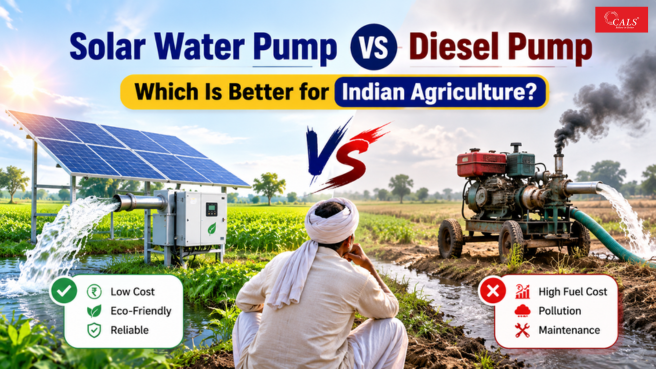
Indian agriculture depends heavily on reliable irrigation to maintain crop productivity and ensure stable farm income. Still, farmers continue to face challenges such as rising diesel prices, unpredictable electricity supply, increasing cultivation costs, and growing pressure to use water and energy more efficiently. Selecting the right irrigation pump has become an important decision that directly affects operational expenses and long-term profitability.
Traditionally, diesel pumps have been widely used in farms due to their availability and relatively low upfront investment: the Solar Water Pump for Agriculture India. With government support, lower operating costs, and increasing awareness of sustainable farming practices, solar pumps are rapidly transforming agricultural irrigation.
In this article, we compare solar water pumps and diesel pumps across key factors such as cost, efficiency, maintenance, environmental impact, and return on investment to help farmers and agri-businesses make an informed decision.
Irrigation Challenges Faced by Indian Farmers Today
Agriculture remains highly dependent on consistent water availability. Yet, farmers often encounter several obstacles that increase irrigation expenses and reduce operational efficiency.
i) Rising Diesel Fuel Costs
Diesel prices have steadily increased over the years, making irrigation more expensive for farmers who rely on diesel-powered pumps. During peak agricultural seasons, fuel expenses can significantly impact farm profitability.
ii) Unreliable Grid Electricity
In many rural regions, electricity supply remains inconsistent. Frequent power cuts and voltage fluctuations often disrupt irrigation schedules, affecting crop growth and productivity.
iii) Increasing Water Demand
As agricultural production intensifies to meet growing food demand, farmers require dependable pumping systems that can deliver water efficiently throughout the year.
iv) High Operating and Maintenance Costs
Traditional pumping systems require regular servicing, repairs, and fuel management, adding to the overall cost of farm operations.
These challenges have encouraged farmers to explore modern irrigation solutions such as Solar Water Pump Solutions in India that offer greater reliability and long-term savings.
Understanding Solar Water Pumps and Diesel Pumps
Before comparing the two technologies, it is important to understand how they operate.
i) What Is a Solar Water Pump?
A solar water pump uses photovoltaic (PV) panels to convert sunlight into electricity, which powers a motor and pump system to draw water from wells, borewells, rivers, ponds, or reservoirs.
Modern Solar Water Pump Solutions in India are designed to support a wide range of agricultural applications, including drip irrigation, sprinkler systems, horticulture, livestock watering, and groundwater extraction.
These systems are especially beneficial in remote and off-grid areas where electricity access is limited.
ii) What Is a Diesel Water Pump?
A diesel water pump operates using an internal combustion engine powered by diesel fuel. The engine drives the pump mechanism, enabling water extraction and distribution for irrigation purposes.
While diesel pumps have served farmers for decades, they remain dependent on fuel availability and ongoing operational expenditures.
Solar Water Pump vs Diesel Pump: A Detailed Comparison
The following comparison highlights the key differences between solar and diesel-powered irrigation systems.
| Parameter | Solar Water Pump | Diesel Pump |
| Initial Investment | Higher upfront cost | Lower upfront cost |
| Fuel Requirement | No fuel required | Continuous diesel consumption |
| Operating Cost | Very low | High and recurring |
| Maintenance | Minimal | Frequent servicing required |
| Lifespan | 20–25 years | 5–10 years |
| Noise Level | Silent operation | High noise generation |
| Environmental Impact | Zero emissions | Produces carbon emissions |
| Reliability | Consistent during sunlight hours | Dependent on fuel availability |
| Government Subsidies | Available under various schemes | Generally unavailable |
| Long-Term ROI | High | Limited |
While diesel pumps may appear economical initially, the lifetime ownership cost often exceeds that of solar-powered alternatives.
Operating Cost Comparison: Which Option Saves More?
One of the most important considerations for farmers is operational expenditure.
i) Diesel Pump Operating Costs
A diesel pump requires continuous fuel consumption. Depending on the size of the farm and irrigation frequency, diesel expenses can accumulate significantly over the years. In addition to fuel costs, farmers must also account for:
- Engine oil replacement
- Filter changes
- Repair expenses
- Transportation and fuel storage costs
- Unexpected breakdowns
These recurring expenses can substantially reduce farm profitability.
ii) Solar Pump Operating Costs
A solar-powered irrigation system generates electricity directly from sunlight, eliminating fuel costs entirely. With Solar Pump Irrigation India, farmers can irrigate fields without worrying about fluctuating fuel prices or electricity tariffs.
After installation, operational expenses remain extremely low, making solar pumps an economically attractive option for long-term agricultural use.
Maintenance and Reliability: Which Pump Requires Less Attention?
Maintenance plays a critical role in determining the total ownership cost of any irrigation system.
i) Solar Water Pumps
Solar pumps contain fewer moving parts compared to diesel engines, resulting in lower wear and tear. Benefits include:
- Minimal servicing requirements
- Reduced downtime
- Longer equipment lifespan
- Lower maintenance expenditure
Professional Solar Water Pump Services India ensure that systems continue to operate efficiently through periodic inspections and performance checks.
Many farmers also benefit from comprehensive Solar Pump Maintenance & Installation India support programs that simplify long-term system management.
ii) Diesel Pumps
Diesel engines require regular maintenance to remain operational. Common maintenance activities include:
- Fuel filter replacement
- Engine tuning
- Lubrication
- Cooling system checks
- Component repairs
Frequent servicing increases both maintenance costs and operational interruptions.
Environmental Impact: Importance of Sustainable Irrigation
Sustainability is becoming increasingly important in modern agriculture.
i) Solar Pumps Support Cleaner Adoption
Solar-powered irrigation systems operate without emitting greenhouse gases or pollutants. They contribute to cleaner agricultural practices while reducing dependence on fossil fuels.
As demand for Renewable Energy Services in India continues to grow, solar pumps are helping farmers align with sustainable farming goals and environmental regulations.
ii) Diesel Pumps Increase Carbon Emissions
Diesel pumps release carbon dioxide and other pollutants during operation. Continuous fuel consumption contributes to environmental degradation and increases the carbon footprint of agricultural activities.
For farmers looking to embrace sustainable agriculture, solar irrigation offers a significantly greener alternative.
Government Subsidies and Financial Assistance for Solar Pumps
One of the strongest advantages of adopting solar irrigation systems is access to government incentives.
i) PM-KUSUM Scheme
The Pradhan Mantri Kisan Urja Suraksha evam Utthaan Mahabhiyan (PM-KUSUM) has significantly accelerated the adoption of solar-powered irrigation systems across India. Key benefits include:
- Capital subsidies for eligible farmers
- Reduced installation costs
- Financial assistance for solar pump deployment
- Improved access to renewable energy solutions
Various state-level programs further complement central government initiatives, making Solar Water Pump Solutions in India more affordable for farmers and rural entrepreneurs.
These incentives substantially reduce the payback period and improve overall investment returns.
Return on Investment : Which Pump Delivers Better Value
When evaluating irrigation systems, long-term financial performance matters more than initial purchase price.
i) Diesel Pump ROI Challenges
Although diesel pumps require a lower upfront investment, recurring expenses continue throughout their operational life. Farmers must budget for:
- Fuel purchases
- Maintenance services
- Spare parts
- Repairs
Over several years, these costs can surpass the initial purchase price multiple times.
ii) Solar Pump ROI Advantages
The Solar Water Pump for Agriculture India offers substantial long-term savings through:
- Zero fuel expenses
- Minimal maintenance requirements
- Longer equipment lifespan
- Government subsidies
Depending on usage patterns and subsidy support, many farmers recover their investment within three to five years. After that period, the system continues to generate economic benefits with minimal operational costs.
Which Pump Is Best for Different Farming Requirements?
The ideal irrigation solution depends on farm size, water requirements, and geographic location.
-
Small Farms
For small landholdings, solar pumps provide an affordable long-term solution, especially when subsidy programs are utilized.
-
Medium-Sized Farms
Medium-scale farmers can benefit significantly from Solar Pump Irrigation India due to reduced operating costs and dependable water availability.
-
Large Agricultural Operations
High-capacity solar pumping systems can support extensive irrigation networks while delivering substantial fuel savings over time.
-
Remote and Off-Grid Areas
For farms located in regions with unreliable electricity supply, solar pumps offer unmatched reliability and independence from conventional energy sources.
Working with an experienced Solar Pump Installation Company India ensures proper system sizing, efficient deployment, and optimized performance based on specific agricultural requirements.
The Growing Shift to Solar Irrigation
Several factors are driving the widespread adoption of solar irrigation technologies:
- Elimination of fuel dependency
- Reduced irrigation costs
- Lower maintenance requirements
- Government financial incentives
- Increased energy independence
- Long operational lifespan
- Environmentally responsible farming
Leading providers of Renewable Energy Services in India are helping farmers transition toward sustainable irrigation systems that improve productivity while reducing operational expenses.
As a trusted Renewable Energy EPC Company in India, companies specializing in solar infrastructure are making advanced irrigation technologies more accessible to agricultural communities across the country.
How Cals India Supports with Reliable Solar Irrigation Solutions
With extensive experience in delivering renewable energy infrastructure across India, Cals India helps farmers and agri-businesses adopt dependable solar-powered irrigation systems that are engineered for long-term performance. Every project begins with a detailed assessment of water requirements, land conditions, and irrigation objectives to ensure the most effective solution for the application.
What sets us apart is its commitment to quality engineering, project execution, and lifecycle support:
- Application-specific solar pumping systems designed to maximize irrigation efficiency.
- In-house engineering expertise for accurate system sizing, design, and performance optimization.
- Proven-quality components and technologies that ensure durability and reliable operation in demanding agricultural environments.
- End-to-end project management, including installation, commissioning, monitoring, and technical support.
As a trusted renewable energy EPC partner, Cals India delivers customized on-grid, off-grid, and hybrid solar water pumping solutions that enable farmers to lower operating costs, reduce dependence on conventional energy sources, and achieve sustainable water management with confidence.
Backed by technical expertise and a customer-centric approach, we continue to support India’s transition toward smarter and more efficient agricultural irrigation.
Final Words
The comparison clearly shows that while diesel pumps may offer a lower initial purchase cost, they involve continuous fuel expenses, frequent maintenance, and environmental concerns. In contrast, the Solar Water Pump for Agriculture India provides long-term economic advantages through lower operating costs, government subsidies, extended lifespan, and sustainable energy utilization.
As Indian agriculture continues to modernize, solar irrigation is emerging as the preferred choice for farmers seeking reliable, cost-effective, and environmentally responsible water management solutions. With increasing adoption of Solar Water Pump Solutions in India, farmers can improve irrigation efficiency, reduce dependency on fossil fuels, and strengthen long-term farm profitability.
Expand your agricultural product portfolio with trusted solar water pump solutions from Cals India. Deliver greater value, efficiency, and sustainability to your customers.
Frequently Asked Questions
1. What is better for farming: a solar water pump or a diesel pump?
For most agricultural applications, solar water pumps offer better long-term value due to lower operating costs, reduced maintenance, and government subsidy support.
2. How much can farmers save with a solar water pump?
Farmers can eliminate recurring diesel expenses and significantly reduce irrigation costs over the system’s lifespan.
3. Are solar water pumps suitable for Indian agriculture?
Yes. The Solar Water Pump for Agriculture India is highly suitable due to the country’s abundant sunlight, growing irrigation demand, and supportive government initiatives.
4. How long does a solar water pump last?
Most solar pumping systems can operate efficiently for 20–25 years with proper maintenance.
5. Do solar pumps require regular maintenance?
Solar pumps require minimal maintenance compared to diesel pumps, making them easier and more cost-effective to operate.

Comments are closed